Skip to content
Contact Us
Start a Project info@nexlavision.com
GovGraph
Engineering governance · AI-assisted developmentMVP — private pilot

Engineering governance for software built with AI agents

Jira manages work. GitHub manages code. AI agents now do a growing share of both. GovGraph shows whether that work was authorised, why it happened, what changed and what proves it, and tells you when a later commit has moved past the approval or the evidence that was supposed to cover it.

What happens next: we reply by e-mail from info@nexlavision.com within one business day to arrange your GovGraph private pilot. Prefer to talk? Call +92 321 4184187.

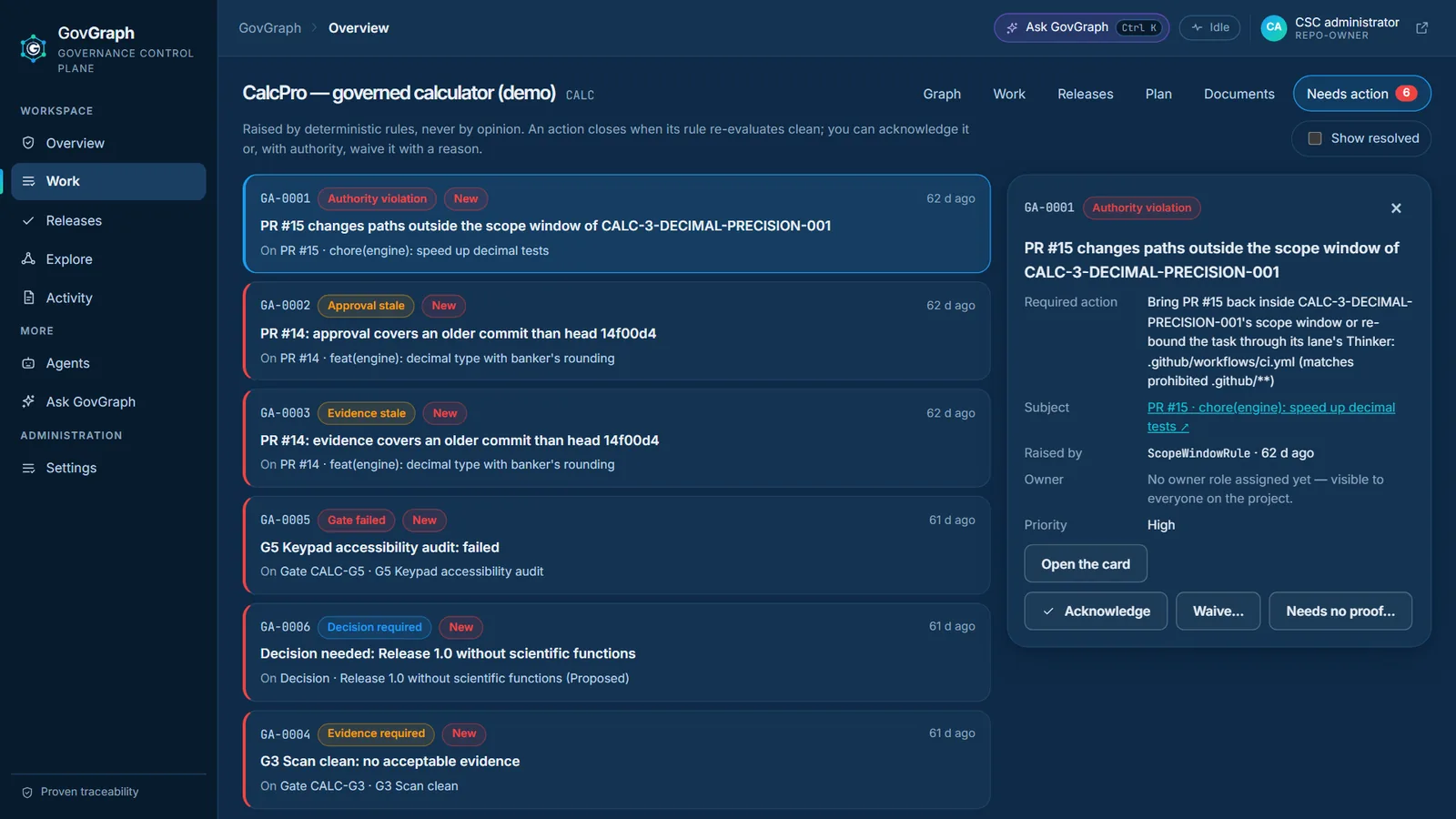
GovGraph Needs action list for a demonstration project: an authority violation, a stale approval, stale evidence, a failed gate, a decision required and missing evidence, each naming the pull request or gate it concerns
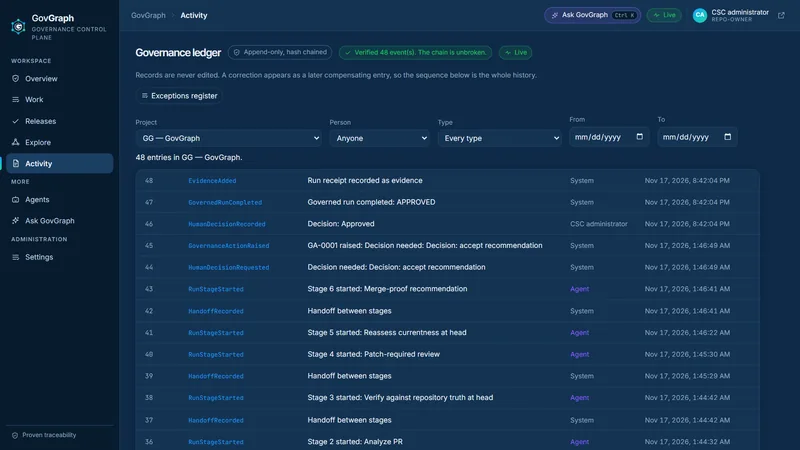
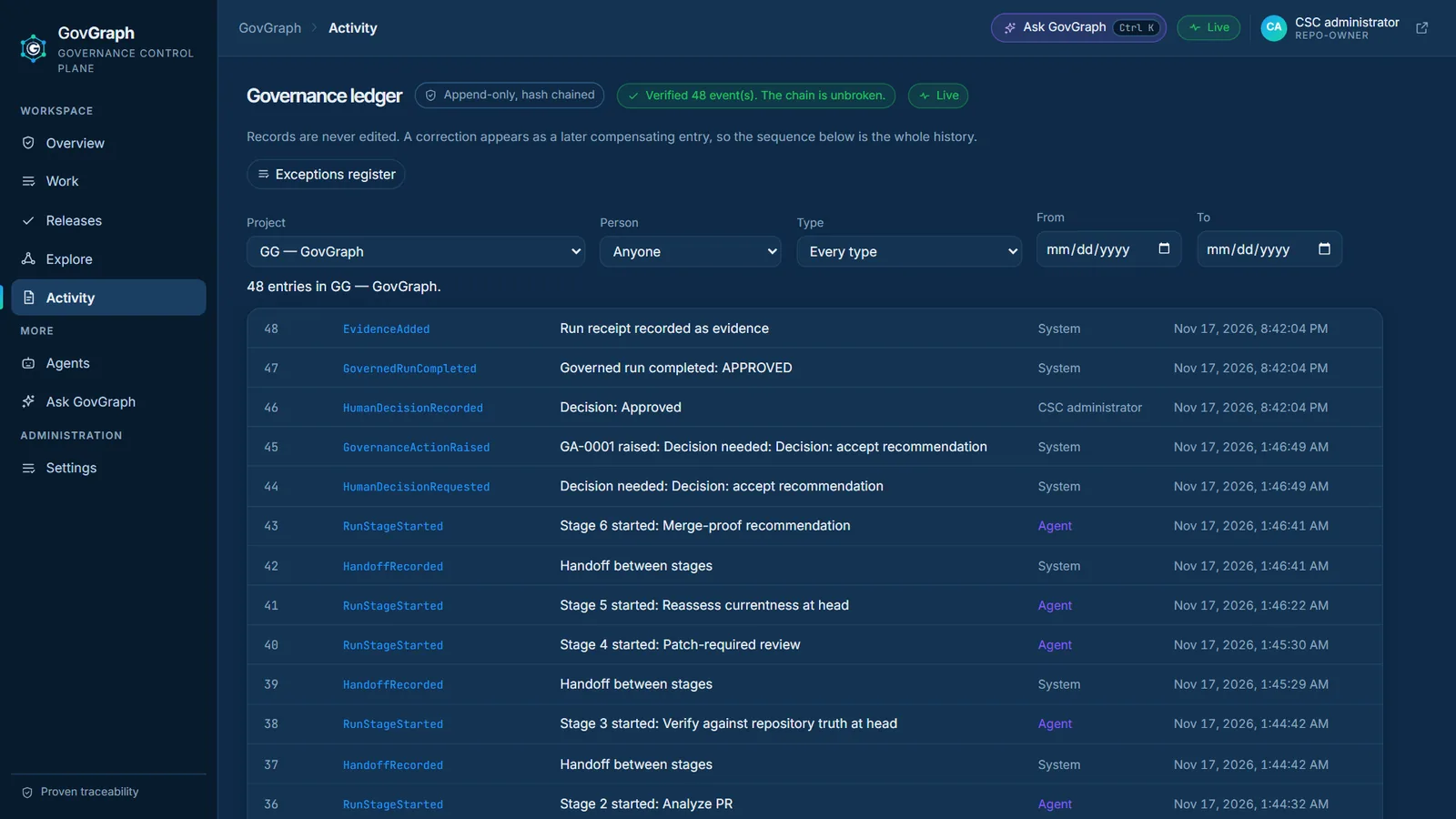
GovGraph governance ledger marked append-only and hash chained, with 48 verified events and an unbroken chain
Real screens · demonstration project
Stale approvalsSee when a later commit has moved past the approval meant to cover it.Detected, not assumed
Missing evidenceWork with no accepted, current proof reads as unknown, never as a pass.Gaps stay visible
Read-onlyRead access to your GitHub repository. Your code is never modified.Observes, does not write
On the recordEvery event goes to an append-only, hash-chained ledger you can verify.Nothing edited
Inside GovGraph

What needs attention, and why

Management can usually see activity. What is hard to see is whether a change was authorised, what it was for and what proves it. These three screens answer that for one project.

01Needs action. Findings raised by rules, never by opinion: a change outside its scope, an approval or evidence that covers an older commit, a failed gate, a decision owed. Each closes when its rule re-evaluates clean.
GovGraph Needs action screen listing six open findings with a detail panel giving the required action, the pull request concerned, the rule that raised it and the choices to acknowledge or waive
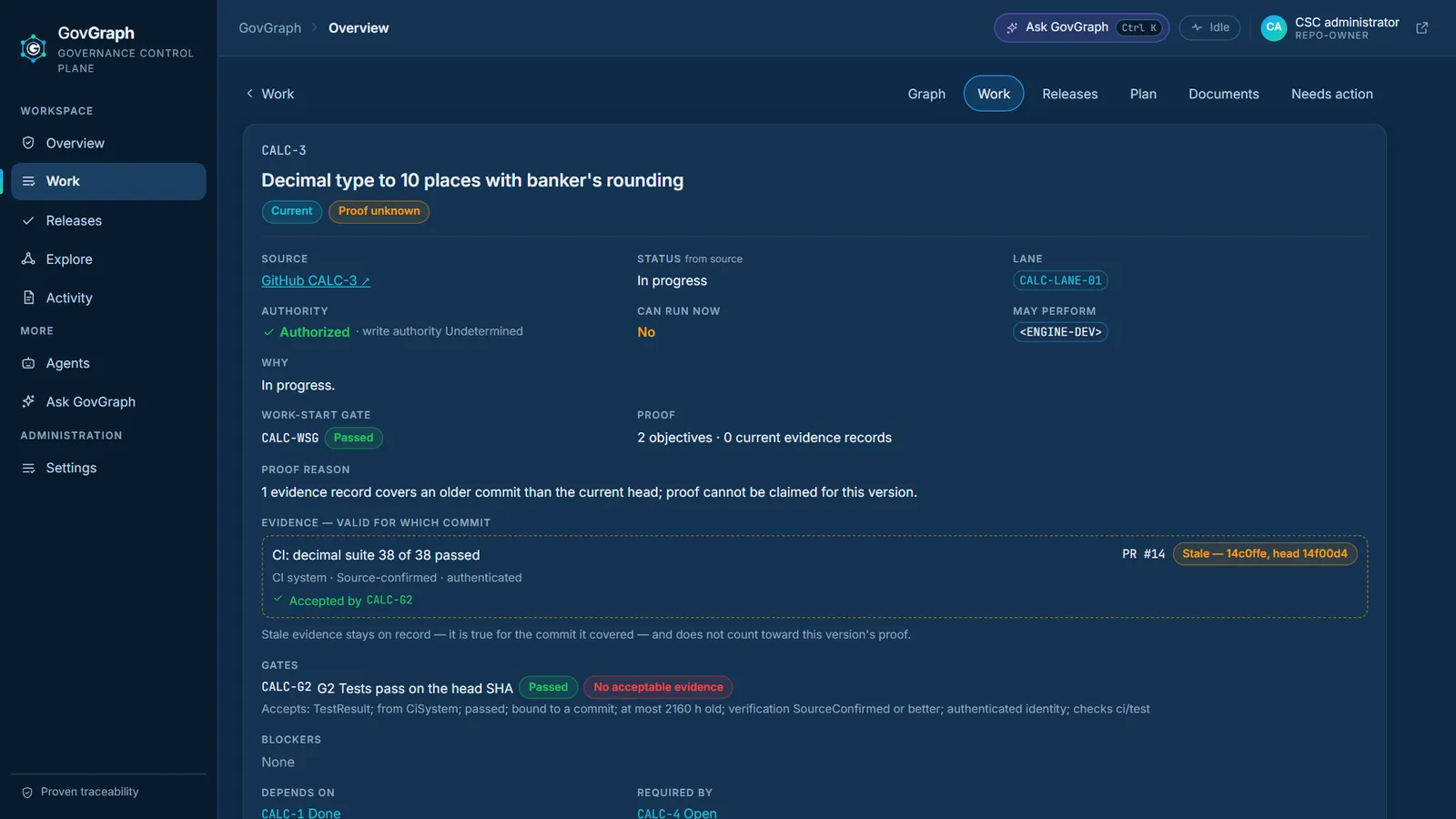
02Work item. One card answers the questions in order: where the work came from, who is authorised, whether it can run now, and what proves it. Evidence for an older commit stays on record and is shown as stale.
GovGraph work item card with source, authority, can run now, proof state unknown, a test evidence record marked stale against the current commit and the gates that apply
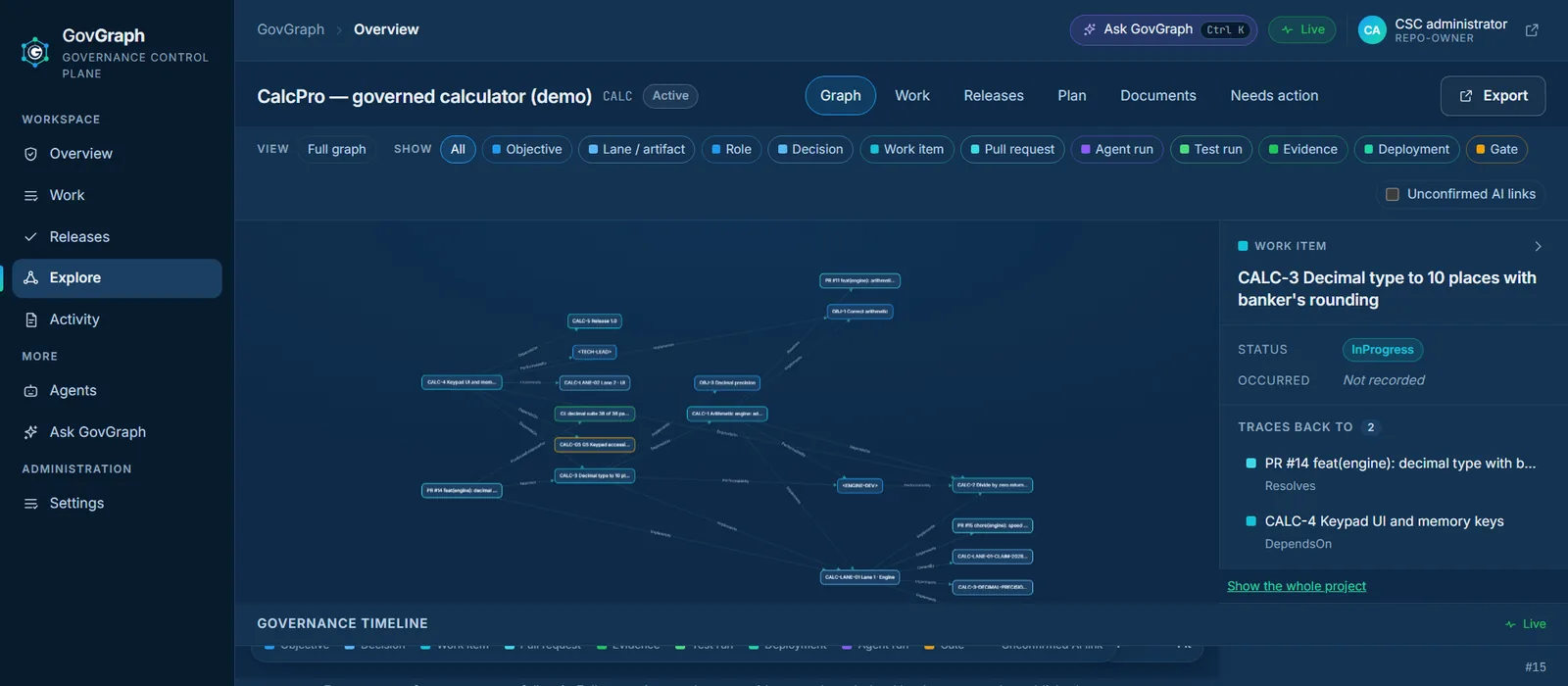
03Governance graph. Open the graph around one record and follow the links outward: objective, lane, decision, work item, pull request, agent run, evidence, gate. You can see where the chain stops.
GovGraph governance graph focused on one work item, with filters by record type and a side panel listing the pull request and work item it traces back to

Real screens of the product, showing a demonstration project

What it does

The chain from objective to proof

No single record is the product. The value is the connected chain, with authority and proof on it: objective, authority, work, the person or agent who acted, the pull request, the evidence, the gate and the decision.

Why and who

Trace a change to its reason

Follow a pull request back to the work item, the decision and the objective it was meant to serve. When someone asks why a change was made, the answer is one view, not an afternoon across the tracker, the repository, the chat and the architecture documents.

Projects with plans, objectives and gates

A project carries its master plan, its objectives, the lanes of work and the gates a release must pass. Work items and governance actions hang off those, so each piece of work has a stated purpose and a stated bar.

What still holds

Approvals and evidence that go stale

An approval and a test result each belong to a specific commit. When later commits land, GovGraph compares the two and tells you the approval or the evidence covers an older commit, so it stops reading as current.

Proof can be unknown

A check that never ran and a check that passed are different answers. Proof needs accepted, current evidence; where that is missing or a source has gone quiet, the state is unknown, with the reason beside it.

Waivers with a name and a reason

A finding can be acknowledged, or waived by someone with the authority to do so, with a written reason. Nothing is deleted. An exceptions register lists every waiver together, because the risk in an exception is the pattern.

Around the repository

A read-only repository connection

Connect a GitHub repository with read access. GovGraph reads pull requests, commits and changed paths to build the graph. It does not write to the repository.

Ask GovGraph

Ask a question about a project in plain language: what can run now, what needs action, why a work item is blocked. The rules decide the answer; a model explains it, citing the facts it was given, and each answer shows its sources. The model can be a hosted one or a local one, and a project policy states whether its content may leave your network at all.


Governed runs

Staged reviews that end in a human decision

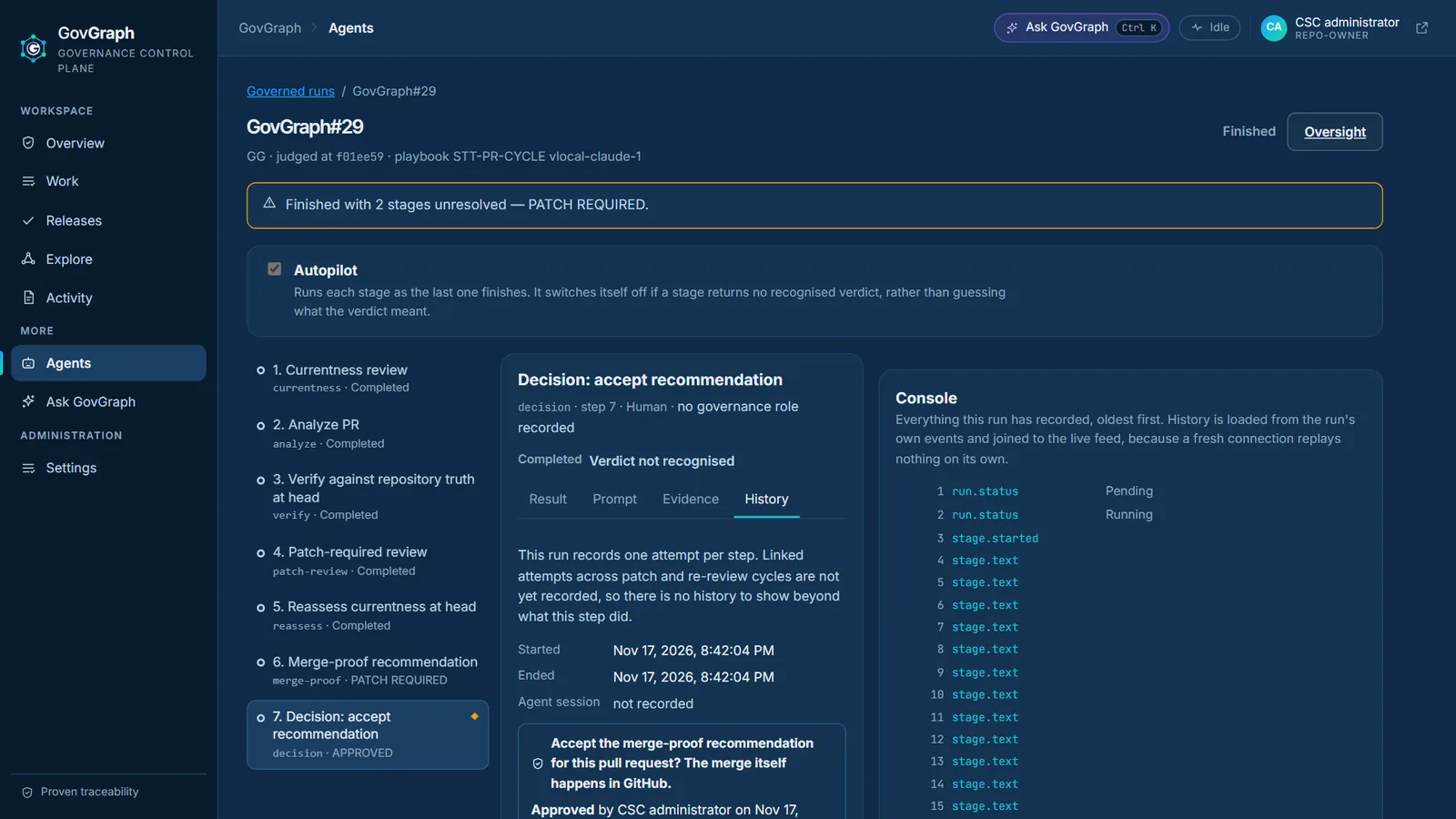
A playbook is an ordered set of review stages for a pull request. One model thinks, another verifies against the repository, and a person decides. Every stage leaves a record.

A finished GovGraph governed run with seven stages from currentness review to a human decision, the final stage showing the question put to the person and the recorded approval
A governed run. Seven stages on one pull request, ending at the decision a person made. The run finished with two stages unresolved and says so.
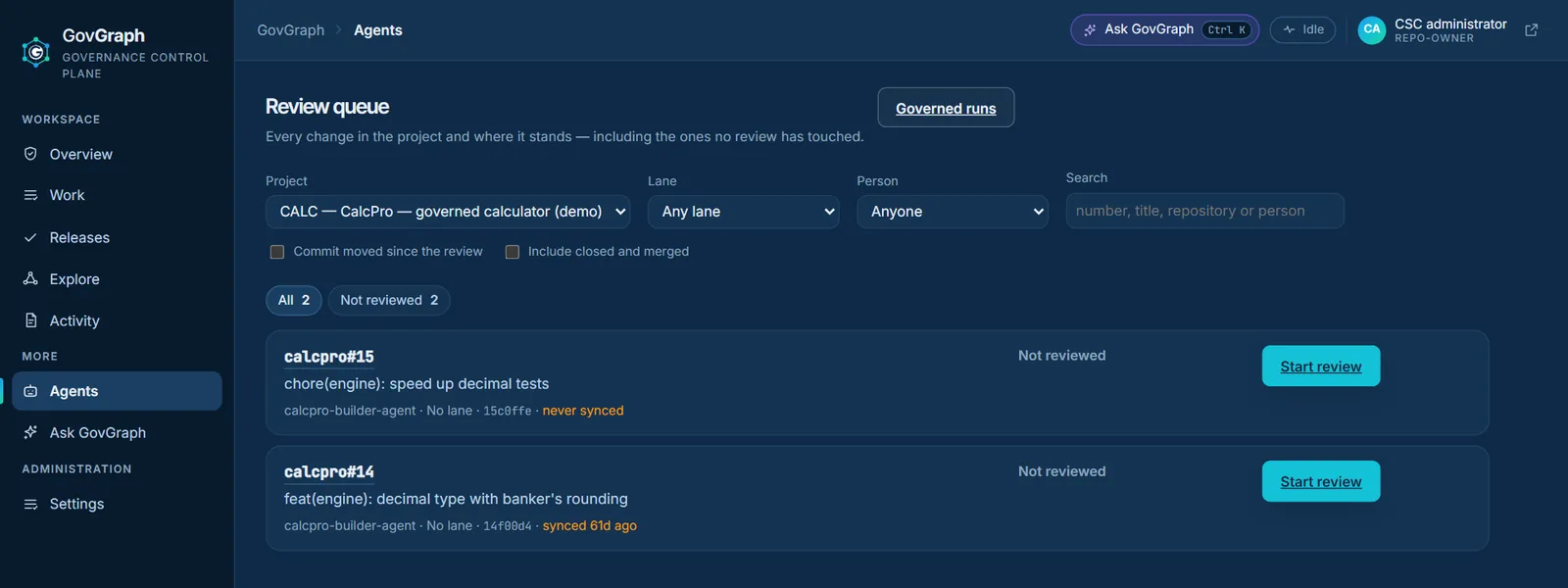
GovGraph review queue for the demonstration project listing two pull requests, both not yet reviewed, with the option to start a review
Review queue. Every pull request in the project and where it stands, including the ones no review has touched.
  • Thinker and Verifier. A Thinker model analyses the change and recommends. A Verifier reads the repository at the commit under review and checks the claims against the code. Each acts under a named governance role, and each stage's prompt, output and handoff are kept.
  • The runner stays on your side. Stages that read a repository run on a runner you register on your own machine, permitted only the repositories you list. A stage can use a hosted model or a local one.
  • A person closes it. The last stage is a decision gate: a signed-in person accepts or rejects the recommendation, and that decision is recorded. Publishing a playbook freezes its prompts, so a run can always be traced to the exact text it followed.
Ledger and evidence

An append-only ledger, and a package for the release

Governance records are only useful if they cannot be quietly changed afterwards, and if you can hand them to someone else in a form that states its own limits.

GovGraph governance ledger showing numbered entries for run stages, handoffs between stages, a human decision, a completed governed run and a run receipt recorded as evidence, with the chain verified as unbroken
Governance ledger. Records are never edited; a correction is a later entry. Each entry is chained to the one before it by a hash, an integrity check verifies the chain, and a finished run leaves a receipt that is itself recorded as evidence.
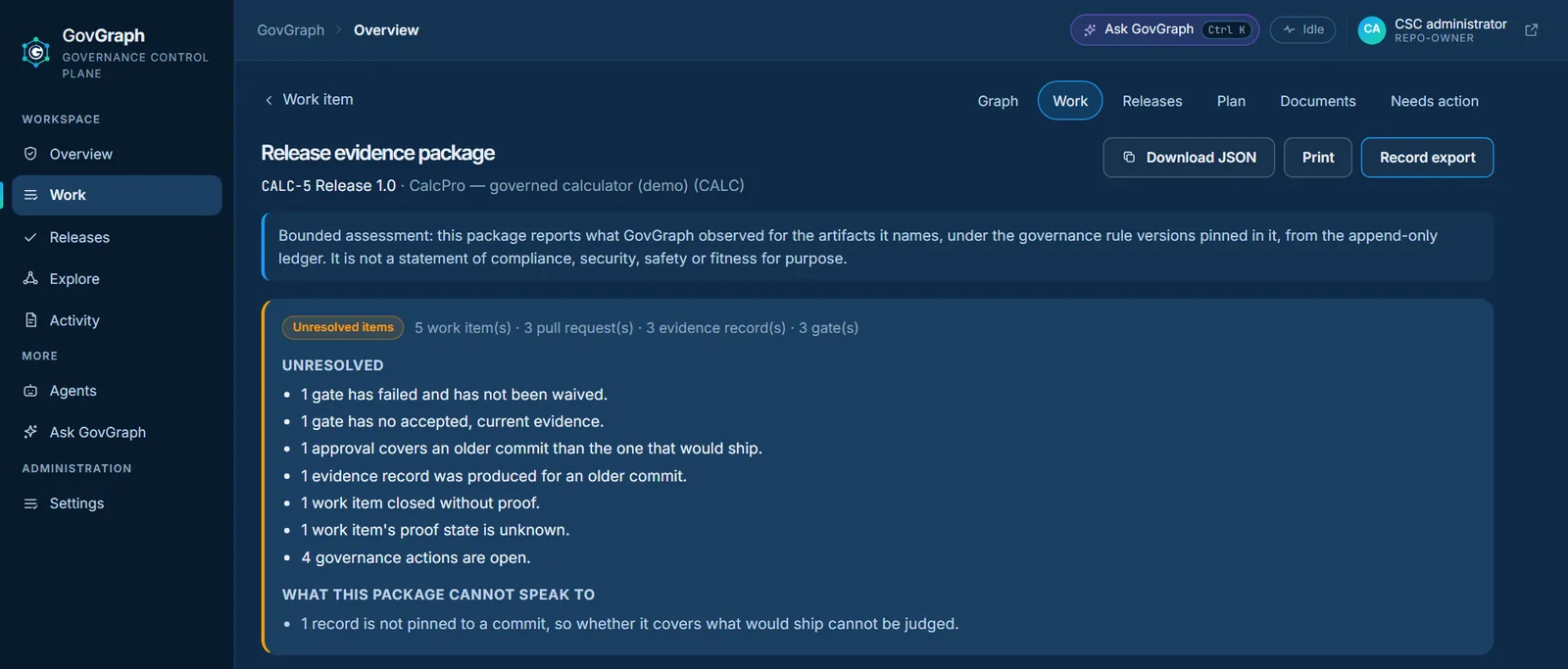
GovGraph release evidence package for a demonstration release, with its bounded assessment statement, a list of unresolved items and a section stating what the package cannot speak to
Release evidence package. The work in a release with its proof states, pull requests, approvals, gates and exceptions, the ledger verdict and a content digest. It lists what is unresolved and what it cannot speak to, and it can be downloaded or printed.
The boundary

Assessment, not enforcement

Being precise about this boundary is part of the product. GovGraph reports; your existing tools still decide.

  • It does not grant approval. People approve. GovGraph records that an approval happened and tells you when it stops covering the current code.
  • It does not enforce actions elsewhere. It will not block a merge or change state in GitHub. Detection is not prevention.
  • It does not certify compliance. It produces traceable evidence that supports an audit. Certification against a standard is not something a tool can assert on your behalf.
  • It does not assess what it cannot see. A rule with no available evidence is reported as unassessed, with the reason, never quietly as satisfied.
Administration

Workspaces, members and roles

Each customer is a workspace, kept apart from every other. Inside it you decide who may do what.

  • Members and roles. Invite people and give them roles. A role carries named permissions, from reading the graph to changing governance or deciding a run.
  • AI connections and project policy. Name the model connections a workspace may use, and state per project whether content may be processed outside your network.
  • Repositories and runners. Connect repositories read-only and register the runners allowed to read them.
  • Operator console. We administer workspaces and entitlements from a separate console that does not read a customer's governance data. Support access into a workspace is time-boxed and appears in that customer's own ledger.
Where it stands today

A working product, at pilot stage

GovGraph runs end to end and we use it on our own repositories. It is offered as a guided private pilot, not as a public service.

Built and running

  • Projects, objectives, gates, work items and governance actions
  • Findings for stale approvals, stale or missing evidence, failed gates, scope violations and decisions owed
  • The governance graph and the activity timeline
  • Read-only GitHub connection and the review queue
  • Playbooks, governed runs and the human decision gate
  • The hash-chained ledger with its integrity check
  • Release evidence packages and the exceptions register
  • Workspaces, members, roles and the operator console

Limited

  • GitHub only, connected with an access token; a GitHub App installation is not available yet
  • A pilot starts with one repository and guided setup
  • An agent's authority is recorded and checked after the fact; it is not enforced before the agent acts
  • Automatic gate evaluation is still partial

Not available yet

  • Connections to Jira, Azure DevOps or CI systems
  • Public sign-up or a hosted self-service plan
  • Published pricing
  • Blocking a merge or enforcing a rule in another tool
  • Any certification of the product or of your compliance
Who it is for

Teams that have to show their work

Engineering leaders

Using AI coding agents across several repositories or teams, and asked whether that work is under control.

Regulated software teams

Healthcare, fintech, insurance and public-sector suppliers who must show why a change was made and how it was validated.

Architects and release owners

Who today check documents, pull requests, tickets and logs by hand to decide whether a gate was really satisfied.

FAQ

GovGraph, answered

It connects the objective, the decision, the work item, the pull request, the evidence and the gate behind a change into one traceable view, so you can see which approvals no longer cover the current code and which records have no proof behind them.

No. It connects to a GitHub repository with read-only access and never writes to your code, branches or pull requests. GovGraph does keep its own governance records and ledger, and those live in GovGraph.

GitHub only at this stage, one repository at a time with guided setup, using an access token with read access. Connections to Jira, Azure DevOps and CI systems are not available yet.

No. It assesses the state of work against the rules you configure and the evidence it can see, and reports what it finds. It does not block a merge, grant an approval or change anything in GitHub. The merge itself still happens in GitHub.

No. It produces traceable records and evidence packages that support a review or an audit. Every package states that it is a bounded assessment and not a statement of compliance, security, safety or fitness for purpose.

A governed run takes one pull request through a playbook of review stages. A Thinker model analyses and recommends, a Verifier reads the repository on a runner you host and checks the claims against the code, and the run ends with a person accepting or rejecting the recommendation. Each stage's output is recorded on the ledger.

Nothing about pass or fail. Findings are raised by deterministic rules, and a governed run ends at a human decision. Models analyse, verify and explain, and their output is kept with the sources it used so a person can check it.

GovGraph is a working product at pilot stage. We run guided private pilots with engineering teams; there is no public sign-up, no hosted self-service plan and no published price.

Start with one repository and one real finding

We are inviting engineering teams that use AI coding tools to evaluate GovGraph in a guided private pilot. Connect one repository read-only, review a real governance finding and look at the evidence behind it.

What happens next: we reply by e-mail from info@nexlavision.com within one business day to arrange your GovGraph private pilot. Prefer to talk? Call +92 321 4184187.

Free consultation

Free Consultation Available

Looking at GovGraph for your engineering team?

Leave your name and number and tell us which product you are looking at. We will call or message you to understand what you need and prepare a quote.

Include the country code, for example +92 300 1234567

or

  • No obligation
  • English and Arabic
  • Six products